Boat noodle, and what the takeaway serves
The gap between a Bangkok stall's bowl and a Canadian menu is mostly Thai-Chinese cooking, and that is a history rather than a compromise.
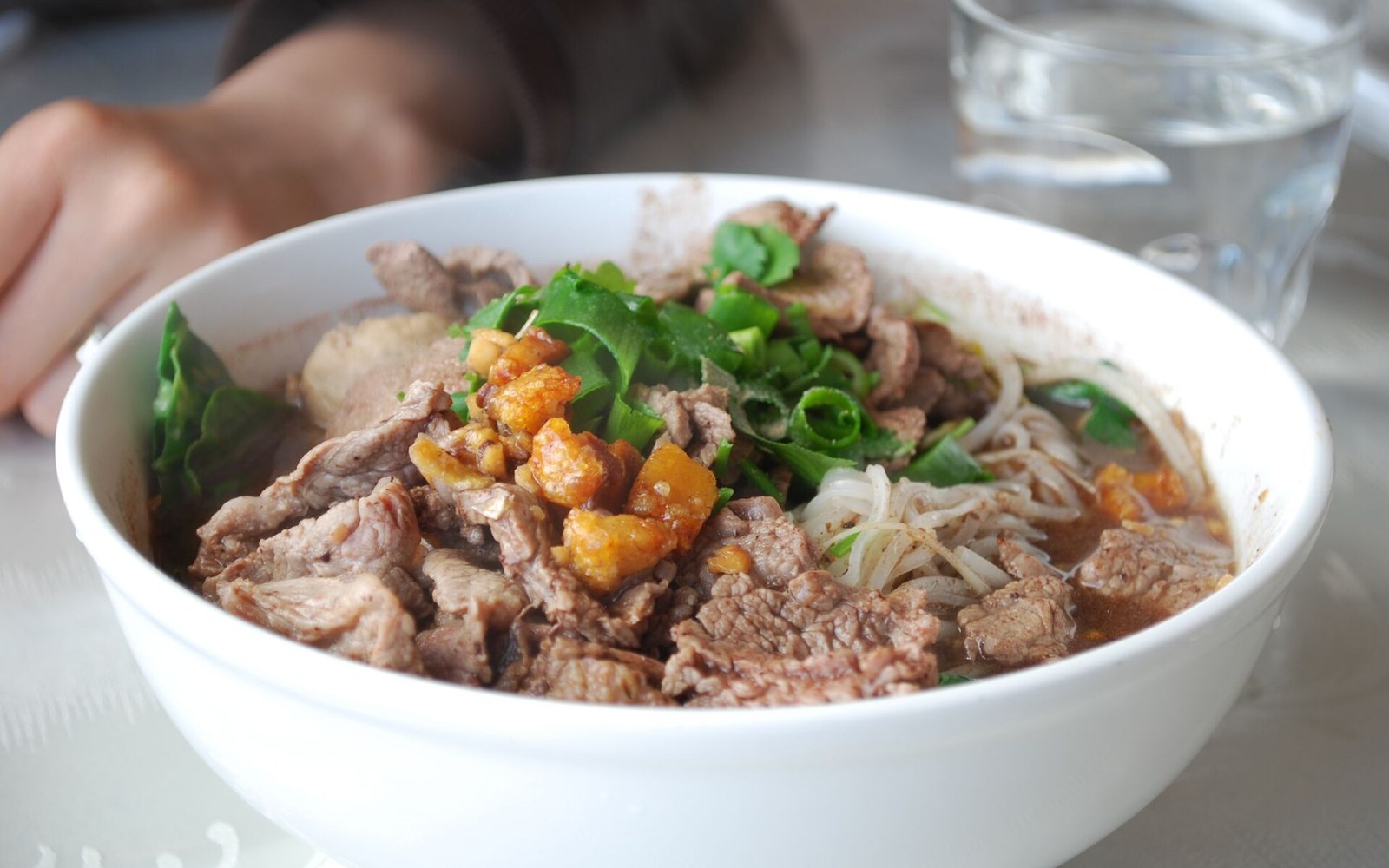
What the bowl actually is
Boat noodle — kuay tiew reua in Thai, literally "noodle of the boat" — has a specific origin. From roughly the 1940s through to the 1970s, vendors on Bangkok's canals sold small bowls of broth from narrow wooden boats, ladling out portions directly to customers on the bank or passing in their own craft. The bowls were small by necessity: storage space was tight, turnover had to be fast, and a customer might eat four or five in a sitting rather than one large portion. The broth was built to punch — pork or beef blood was stirred in to thicken it, along with dark soy, star anise, cinnamon and a quantity of aromatics that deepened over a day's cooking. The result was something intensely dark and savoury, closer to a medicinal stock than a light soup.
That intensity is the point Thai food historians reach for when explaining what made boat noodle distinct. It was not merely noodle soup; it was a particular density of flavour calibrated to a small vessel and a hot canal-side morning. The canal trade thinned as Bangkok's waterways were progressively paved and filled from the 1960s onward, and the vendors moved to fixed stalls, particularly around the Victory Monument area, where kuay tiew reua shops still concentrate. The small bowl convention survived: you order in multiples, and the price per bowl stays low.
The Thai-Chinese kitchen underneath it
What a Bangkok boat noodle bowl and a Richmond or Surrey takeaway menu share is a substrate that is not easily reduced to either "Thai" or "Chinese" — it is Thai-Chinese, and that hyphen carries a real history. The Teochew community, who migrated to Thailand in significant numbers across the nineteenth and early twentieth centuries, brought with them a noodle and broth culture that fused steadily with local ingredients and the Theravada-adjacent food rhythms of the central plain. The thin rice noodle, the clear pork broth, the use of preserved vegetables and white pepper — these are Teochew in origin, domesticated so thoroughly into Thai cooking that separating them now would be an act of archaeology rather than cooking.
Boat noodle sits inside that tradition. The blood-thickened broth is not a universal Thai technique; it belongs to a particular stream of Bangkok street food that the Thai-Chinese community shaped and kept. When Vancouver's Thai cooks trained — in Bangkok, in Chiang Mai, in the central plain towns that feed the city — they learned this food as simply Thai, because it is. The hyphen is a matter of record, not of dilution.

What a Canadian menu gives you, and why
The gap between a Bangkok bowl and what a takeaway in Vancouver serves is real, but it is not mainly a gap of ambition. It is a gap of logistics and portion convention. Blood is difficult to source fresh in the quantities a restaurant needs; the dark, iron-forward broth it produces can alarm customers who encounter it without context. Most local menus offer a version with a cleaner beef or pork stock, still spiced, still darker than a standard pho, but less confrontational. The small-bowl convention rarely survives: a Canadian lunch expectation is a single large bowl, which means the broth-to-noodle ratio shifts and the cumulative effect of eating five small intense portions is simply lost.
What does survive — sometimes — is the topping logic: the braised pork belly or beef tendon, the crisp fried garlic, the morning glory or bean sprouts, the tableside condiments of fish sauce, dried chilli, sugar and vinegar that let a diner calibrate the bowl themselves. That four-condiment set is one of the most recognisable signatures of Thai-Chinese noodle culture, and it travels. What a grocer here can actually get includes the aromatics — galangal, makrut lime leaf, star anise — that underwrite the broth, so the spice profile is achievable; it is the blood, the boat-scale portion and the canal-morning context that do not cross.
The takeaway is not a diminished version of the stall. It is the same tradition, adapted to a different city's storage, supply chain and lunch hour.
More in And in Vancouver